Educational Model Redevelopment Project

Examining and redefining how instructional models, grade configurations, program delivery, and physical learning environments work together to support the instructional, social-emotional, and collaborative learning needs of our students.

A school district’s Educational Model is the big-picture framework that reflects the values of the school district and its community, defining how teaching and learning take place across all schools in the system. A district’s Educational Model ties together grade configurations, curriculum, instruction, assessment, and culture, creating a consistent pathway designed to help every student succeed. Redeveloping our Educational Model represents a proactive, strategic step toward ensuring that Dedham Public Schools remains a future-ready, student-centered district able to make well-informed, creative, and fiscally responsible decisions that balance the dual imperatives of educational innovation and facility sustainability.

A new Educational Model will integrate academic visioning, community engagement, and facilities strategy into a comprehensive framework for long-term transformation.

Who's Leading This Effort?

The work on developing an updated Educational Model for the District is being conducted under the guidance of an appointed Dedham School Committee subcommittee chaired by Josh Langmead, along with Chris Polito and Anthony Rodriguez, and in close collaboration with the DPS Leadership team.

Dedham Public Schools has partnered with the Rennie Center for Education Research & Policy to lead a data-driven process to examine and update Dedham’s Educational Model. The Rennie Center is a local education-focused non-profit based in Boston, MA whose mission is to improve public education through well-informed decision-making that’s based on deep knowledge and evidence of effective policymaking and practice. They are a nonpartisan organization that works to advance and connect research, practice, and policy, to promote systems that champion student success.
The Project Timeline

The Ed Model Redevelopment project will be conducted in three phases:

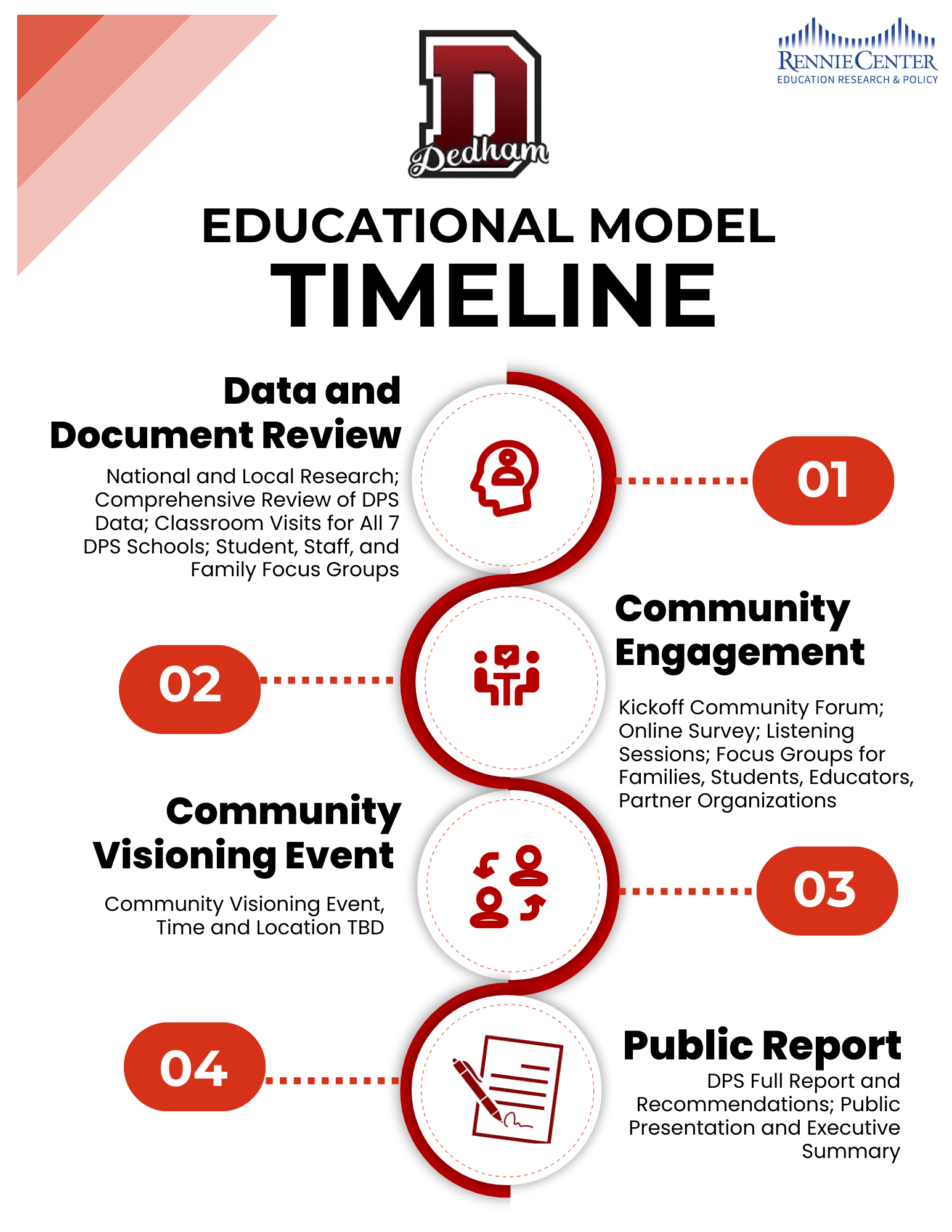
Phase 1 is Data and Document Review, encompassing National and Local Research; Comprehensive Review of DPS Data; Classroom Visits for All 7 DPS Schools; and preliminary Student, Staff, and Family Focus Groups.

Phase 2 is focused on Community Engagement, where the Dedham community is invited to share its voices and perspectives on what Dedham Public Schools should prioritize moving forward. That phase will culminate in a Community Visioning Event, held in conjunction with the town of Dedham’s Art Show in May 2026.

Phase 3 is about the report and next steps. The Rennie Center will publish everything found and heard during the first two phases in a public report and presentation: The report will include findings, recommendations, and options for DPS moving forward. This actionable educational model redesign plan will provide a roadmap for aligning the structures, staffing, and facilities with Dedham Public Schools’ mission and strategic goals.


Examining and redefining how instructional models, grade configurations, program delivery, and physical learning environments work together to support the instructional, social-emotional, and collaborative learning needs of our students.

A school district’s Educational Model is the big-picture framework that reflects the values of the school district and its community, defining how teaching and learning take place across all schools in the system. A district’s Educational Model ties together grade configurations, curriculum, instruction, assessment, and culture, creating a consistent pathway designed to help every student succeed. Redeveloping our Educational Model represents a proactive, strategic step toward ensuring that Dedham Public Schools remains a future-ready, student-centered district able to make well-informed, creative, and fiscally responsible decisions that balance the dual imperatives of educational innovation and facility sustainability.

A new Educational Model will integrate academic visioning, community engagement, and facilities strategy into a comprehensive framework for long-term transformation.

Who's Leading This Effort?

The work on developing an updated Educational Model for the District is being conducted under the guidance of an appointed Dedham School Committee subcommittee chaired by Josh Langmead, along with Chris Polito and Anthony Rodriguez, and in close collaboration with the DPS Leadership team.

Dedham Public Schools has partnered with the Rennie Center for Education Research & Policy to lead a data-driven process to examine and update Dedham’s Educational Model. The Rennie Center is a local education-focused non-profit based in Boston, MA whose mission is to improve public education through well-informed decision-making that’s based on deep knowledge and evidence of effective policymaking and practice. They are a nonpartisan organization that works to advance and connect research, practice, and policy, to promote systems that champion student success.

The Project Timeline

The Ed Model Redevelopment project will be conducted in three phases:

Phase 1 is Data and Document Review, encompassing National and Local Research; Comprehensive Review of DPS Data; Classroom Visits for All 7 DPS Schools; and preliminary Student, Staff, and Family Focus Groups.

Phase 2 is focused on Community Engagement, where the Dedham community is invited to share its voices and perspectives on what Dedham Public Schools should prioritize moving forward. That phase will culminate in a Community Visioning Event, held in conjunction with the town of Dedham’s Art Show in May 2026.

Phase 3 is about the report and next steps. The Rennie Center will publish everything found and heard during the first two phases in a public report and presentation: The report will include findings, recommendations, and options for DPS moving forward. This actionable educational model redesign plan will provide a roadmap for aligning the structures, staffing, and facilities with Dedham Public Schools’ mission and strategic goals.


  • Project Update - August 13, 2026: Key Findings from Educational Model Redevelopment Report Focused on Grade and School Configurations

    At its August 13 meeting, the Dedham School Committee reviewed the first of two reports from the Rennie Center for Education Research & Policy as part of Dedham Public Schools’ Educational Model Redevelopment process. The report presented last night focuses on grade configuration and school facilities options and offers recommendations for how Dedham can create stronger learning environments for students while making thoughtful, long-term investments in its schools.

    The Educational Model Redevelopment has been a collaborative effort designed to align Dedham’s educational vision, instructional practices, and facilities planning around a shared goal: preparing students for lifelong success in a rapidly changing world. The Rennie Center has worked closely with Arrowstreet, the architectural firm supporting the Town of Dedham’s Facilities Master Planning process, so that educational priorities and future facility decisions can move forward together. Three of the scenarios presented will be further evaluated and considered in more detail through the Facilities Master Plan.

    A Process Grounded in Data and Community Input

    Over the course of the Educational Model Redevelopment project, the Rennie Center generated over 250 graphs on student enrollment, demographics, staffing, and performance data; examined 13 peer comparison districts; visited all seven Dedham schools; interviewed district and school leaders; observed learning in over 30 classrooms; and held 17 focus groups with staff, students, and families.

    The process also provided multiple opportunities for broader community input, including five listening sessions, a community survey that yielded over 760 responses, a visioning event with ~100 votes per station and 80 open responses with additional feedback shared, and additional focus groups with key community organizations. Community members were asked what is working well today, where gaps exist, and what changes could better serve Dedham students in the future.

    A List of Ten Possible Options For Consideration

    Having developed a full slate of facilities scenarios, the Rennie Center and Arrowstreet narrowed the options to eliminate options that were not feasible given district data and enrollment trends, local and national educational models, priorities expressed by Dedham residents, available lands and considerations of feasible spatial, facilities-oriented, and space-planning concepts based upon MSBA guidelines.

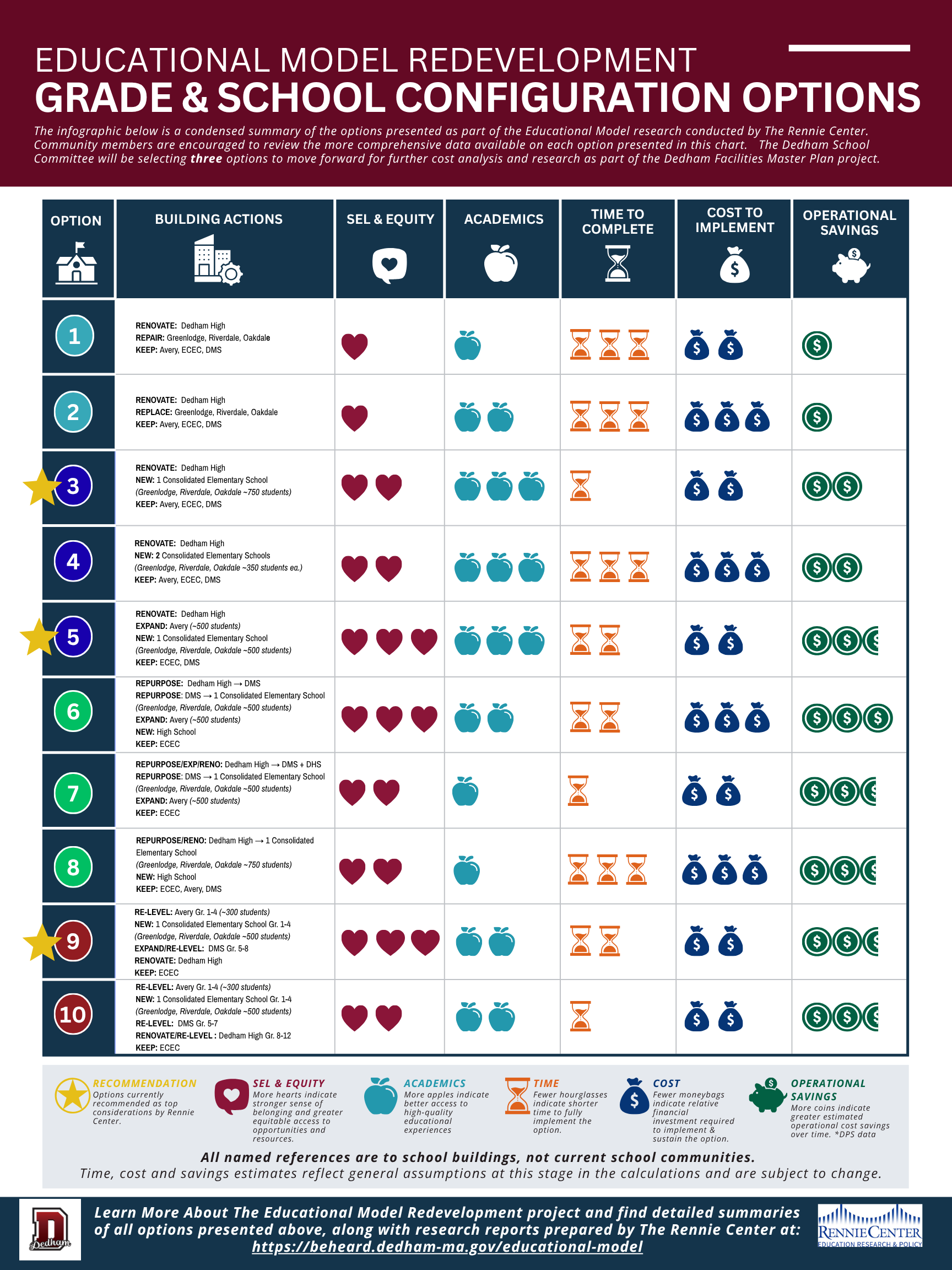
    A final list of ten scenarios was presented as part of the report, based on four strategic approaches, and coded with a comparative rating scale that shows the the potential benefits and drawbacks each one offers to Dedham based on both educational and operational factors, including social emotional and equity impacts, academic impacts, time and cost. In developing these options, the report intended to answer questions such as how students should learn, how buildings should support teaching and learning, and what grade spans work best for Dedham students. As noted by Grace Wang who was presenting the report for the Rennie Center, “Every scenario has its pros and cons. Our goal is to maximize DPS students’ learning experiences while minimizing the time/cost for Dedham.”

    At the conclusion of the report, the Rennie Center provided a recommendation of three scenarios from the ten presented, which based on their research would serve as the optimal choices for Dedham moving forward. Each of the three recommended options has its own benefits and drawbacks, but all would accomplish the purpose of moving elementary school students into higher-quality spaces more quickly, which emerged from the research as a clear priority expressed by the Dedham community. All three options also ranked in the middle tier for cost and none were higher than the middle tier for time, indicating that they could be accomplished for less money, and in a more efficient manner, than other potential plans.

    Additionally, during the meeting, Dedham Public Schools Deputy Superintendent Dr. Ian Kelly, provided additional data for consideration on each option, sharing insight into how each scenario compared based on estimated future operational cost savings with regards to the annual school budget.

    Next Steps & How Community Members Can Learn More

    The School Committee will continue to review the findings, consider community perspectives, and work with district leadership and its partners as Dedham develops a long-term vision for its schools. The School Committee will vote on a final selection of three options from the ten presented in the report in mid to late September. Those three options will be shared with the Facilities Master Plan project for further analysis and consideration. The Facilities Master Plan process will be responsible for determining how to translate those decisions into a capital plan, including where new or renovated buildings would sit, how construction would be sequenced, what swing space might be required, and what should happen to other municipal or school properties. These items are not a part of this Grade Configuration and School Facilities report.

    The School Committee recognizes that changes to school configuration and facilities will have a significant impact on students, families, staff, and the broader community. School Committee members will be working to share the Rennie Center’s report and findings with the Dedham community over the coming weeks, reaching out to community groups and neighborhoods to ensure that residents have a chance to examine the research, review the options presented and share feedback for the committee’s consideration prior to the vote.

    The Educational Model Redevelopment is intended to ensure that future decisions about Dedham’s schools are grounded in what matters most: providing students with strong educational opportunities and learning environments that support their success.

    The Grade Configuration and School Facilities report is the first of two reports connected to the Educational Model Redevelopment. A second report focused on teaching and learning is expected to be presented in September 2026.

    At its August 13 meeting, the Dedham School Committee reviewed the first of two reports from the Rennie Center for Education Research & Policy as part of Dedham Public Schools’ Educational Model Redevelopment process. The report presented last night focuses on grade configuration and school facilities options and offers recommendations for how Dedham can create stronger learning environments for students while making thoughtful, long-term investments in its schools.

    The Educational Model Redevelopment has been a collaborative effort designed to align Dedham’s educational vision, instructional practices, and facilities planning around a shared goal: preparing students for lifelong success in a rapidly changing world. The Rennie Center has worked closely with Arrowstreet, the architectural firm supporting the Town of Dedham’s Facilities Master Planning process, so that educational priorities and future facility decisions can move forward together. Three of the scenarios presented will be further evaluated and considered in more detail through the Facilities Master Plan.

    A Process Grounded in Data and Community Input

    Over the course of the Educational Model Redevelopment project, the Rennie Center generated over 250 graphs on student enrollment, demographics, staffing, and performance data; examined 13 peer comparison districts; visited all seven Dedham schools; interviewed district and school leaders; observed learning in over 30 classrooms; and held 17 focus groups with staff, students, and families.

    The process also provided multiple opportunities for broader community input, including five listening sessions, a community survey that yielded over 760 responses, a visioning event with ~100 votes per station and 80 open responses with additional feedback shared, and additional focus groups with key community organizations. Community members were asked what is working well today, where gaps exist, and what changes could better serve Dedham students in the future.

    A List of Ten Possible Options For Consideration

    Having developed a full slate of facilities scenarios, the Rennie Center and Arrowstreet narrowed the options to eliminate options that were not feasible given district data and enrollment trends, local and national educational models, priorities expressed by Dedham residents, available lands and considerations of feasible spatial, facilities-oriented, and space-planning concepts based upon MSBA guidelines.

    A final list of ten scenarios was presented as part of the report, based on four strategic approaches, and coded with a comparative rating scale that shows the the potential benefits and drawbacks each one offers to Dedham based on both educational and operational factors, including social emotional and equity impacts, academic impacts, time and cost. In developing these options, the report intended to answer questions such as how students should learn, how buildings should support teaching and learning, and what grade spans work best for Dedham students. As noted by Grace Wang who was presenting the report for the Rennie Center, “Every scenario has its pros and cons. Our goal is to maximize DPS students’ learning experiences while minimizing the time/cost for Dedham.”

    At the conclusion of the report, the Rennie Center provided a recommendation of three scenarios from the ten presented, which based on their research would serve as the optimal choices for Dedham moving forward. Each of the three recommended options has its own benefits and drawbacks, but all would accomplish the purpose of moving elementary school students into higher-quality spaces more quickly, which emerged from the research as a clear priority expressed by the Dedham community. All three options also ranked in the middle tier for cost and none were higher than the middle tier for time, indicating that they could be accomplished for less money, and in a more efficient manner, than other potential plans.

    Additionally, during the meeting, Dedham Public Schools Deputy Superintendent Dr. Ian Kelly, provided additional data for consideration on each option, sharing insight into how each scenario compared based on estimated future operational cost savings with regards to the annual school budget.

    Next Steps & How Community Members Can Learn More

    The School Committee will continue to review the findings, consider community perspectives, and work with district leadership and its partners as Dedham develops a long-term vision for its schools. The School Committee will vote on a final selection of three options from the ten presented in the report in mid to late September. Those three options will be shared with the Facilities Master Plan project for further analysis and consideration. The Facilities Master Plan process will be responsible for determining how to translate those decisions into a capital plan, including where new or renovated buildings would sit, how construction would be sequenced, what swing space might be required, and what should happen to other municipal or school properties. These items are not a part of this Grade Configuration and School Facilities report.

    The School Committee recognizes that changes to school configuration and facilities will have a significant impact on students, families, staff, and the broader community. School Committee members will be working to share the Rennie Center’s report and findings with the Dedham community over the coming weeks, reaching out to community groups and neighborhoods to ensure that residents have a chance to examine the research, review the options presented and share feedback for the committee’s consideration prior to the vote.

    The Educational Model Redevelopment is intended to ensure that future decisions about Dedham’s schools are grounded in what matters most: providing students with strong educational opportunities and learning environments that support their success.

    The Grade Configuration and School Facilities report is the first of two reports connected to the Educational Model Redevelopment. A second report focused on teaching and learning is expected to be presented in September 2026.


  • August 13 - UPDATED School Committee Meeting Information

    Thank you for your patience! Due to a compromised online meeting, we will be restarting the planned public School Committee Meeting for August 13,2026 using the following access information. The updated meeting will begin at 6:30pm.

    Topic: Ed Model
    Time: Aug 13, 2026 06:30 PM Eastern Time (US and Canada)
    Join Zoom Meeting
    https://dedham-k12-ma-us.zoom.us/j/92145807635

    Meeting chat link
    https://dedham-k12-ma-us.zoom.us/launch/jc/92145807635

    Meeting ID: 921 4580 7635

    ---

    One tap mobile
    +13052241968,,92145807635# US
    +13092053325,,92145807635# US


    Thank you for your patience! Due to a compromised online meeting, we will be restarting the planned public School Committee Meeting for August 13,2026 using the following access information. The updated meeting will begin at 6:30pm.

    Topic: Ed Model
    Time: Aug 13, 2026 06:30 PM Eastern Time (US and Canada)
    Join Zoom Meeting
    https://dedham-k12-ma-us.zoom.us/j/92145807635

    Meeting chat link
    https://dedham-k12-ma-us.zoom.us/launch/jc/92145807635

    Meeting ID: 921 4580 7635

    ---

    One tap mobile
    +13052241968,,92145807635# US
    +13092053325,,92145807635# US


  • Project Update - August 7, 2026: Project Approaches Final Phase

    The Dedham Educational Model Redevelopment project, which began in March 2026 is reaching its final phase. Under the guidance of an appointed Dedham School Committee subcommittee, the Rennie Center for Education Research & Policy has spent the last five months completing a comprehensive data and document review, classroom visits, focus groups, community engagement forums, online and in-person events, a Community Visioning event in May and a community survey that yielded over 750 responses.

    At the upcoming August 13, 2026 Dedham School Committee meeting (online meeting), the Rennie Center will present the first of two reports from the project that will include findings, recommendations and options for Dedham moving forward.

    The first of these reports will focus on school and grade configuration options, detailing various strategies and scenarios that explore possible ways in which school size, grade distribution and school building environments can be optimized to meet student learning needs. The second report, which will focus on teaching & learning, including curriculum, instruction, assessment, and culture, will be presented at a future meeting in September. The culmination of both reports will result in a new Educational Model for Dedham Public Schools that integrates academic visioning, community engagement, and facilities strategy into a comprehensive framework that will help define how Dedham manages the learning experience of students across all schools in the district.

    The grade and school configuration focused report is being released earlier and separately from the teaching & learning report so that three top options for school and grade configurations can be shared and incorporated into the ongoing work of the Facilities Master Plan project, which is currently examining the facility needs and planning priorities for all Town buildings.

    The Dedham School Committee will be reviewing the published report and options presented, with a goal to identify the top 3 options that will be submitted to the Facilities Master Plan project consultant Arrowstreet, for further cost analysis and research. The vote by the school committee to select the top options to move forward for further research will be conducted in late September.

    The Dedham Educational Model Redevelopment project, which began in March 2026 is reaching its final phase. Under the guidance of an appointed Dedham School Committee subcommittee, the Rennie Center for Education Research & Policy has spent the last five months completing a comprehensive data and document review, classroom visits, focus groups, community engagement forums, online and in-person events, a Community Visioning event in May and a community survey that yielded over 750 responses.

    At the upcoming August 13, 2026 Dedham School Committee meeting (online meeting), the Rennie Center will present the first of two reports from the project that will include findings, recommendations and options for Dedham moving forward.

    The first of these reports will focus on school and grade configuration options, detailing various strategies and scenarios that explore possible ways in which school size, grade distribution and school building environments can be optimized to meet student learning needs. The second report, which will focus on teaching & learning, including curriculum, instruction, assessment, and culture, will be presented at a future meeting in September. The culmination of both reports will result in a new Educational Model for Dedham Public Schools that integrates academic visioning, community engagement, and facilities strategy into a comprehensive framework that will help define how Dedham manages the learning experience of students across all schools in the district.

    The grade and school configuration focused report is being released earlier and separately from the teaching & learning report so that three top options for school and grade configurations can be shared and incorporated into the ongoing work of the Facilities Master Plan project, which is currently examining the facility needs and planning priorities for all Town buildings.

    The Dedham School Committee will be reviewing the published report and options presented, with a goal to identify the top 3 options that will be submitted to the Facilities Master Plan project consultant Arrowstreet, for further cost analysis and research. The vote by the school committee to select the top options to move forward for further research will be conducted in late September.

  • Project Update - July 16, 2026 Report Preview

    Rennie Center Previews Report on Findings for Grade and School Configuration Options

    Dedham Public Schools, in partnership with the Rennie Center for Education Research & Policy is working through the final phase of the review process, which will culminate in an official report and recommendations for a new Dedham Public Schools Educational Model.

    The final report is being released in two parts, the first part providing data and recommendations on grade and school configuration options. The second part of the report to be released will provide recommendations and considerations around teaching, learning and support approaches. The grade and school configuration report and recommendations will be reviewed by the Dedham School Committee, with a scheduled vote for late September, where the Committee will select three options to move forward for further cost analysis as part of the ongoing Facilities Master Plan project.

    At the July 16, 2026 Dedham School Committee meeting, the Rennie Center presented preliminary findings for both parts of the report. These previews were shared for initial consideration of the committee, in advance of the full report pieces expected to be fully released in mid-August and early September respectively.

    Rennie Center Previews Report on Findings for Grade and School Configuration Options

    Dedham Public Schools, in partnership with the Rennie Center for Education Research & Policy is working through the final phase of the review process, which will culminate in an official report and recommendations for a new Dedham Public Schools Educational Model.

    The final report is being released in two parts, the first part providing data and recommendations on grade and school configuration options. The second part of the report to be released will provide recommendations and considerations around teaching, learning and support approaches. The grade and school configuration report and recommendations will be reviewed by the Dedham School Committee, with a scheduled vote for late September, where the Committee will select three options to move forward for further cost analysis as part of the ongoing Facilities Master Plan project.

    At the July 16, 2026 Dedham School Committee meeting, the Rennie Center presented preliminary findings for both parts of the report. These previews were shared for initial consideration of the committee, in advance of the full report pieces expected to be fully released in mid-August and early September respectively.

  • Project Update: May Community Listening Sessions via Zoom

    supporting image

    Dedham Public Schools are in the process of redeveloping the Educational Model, a framework that outlines and shapes how students will learn, grow and succeed as part of our school District. Community voice is especially important in this process, as the Educational Model helps define how students are prepared for life and careers after graduation, how our school facilities and support structures impact learning and how to navigate long-term financial sustainability.

    How You Can Participate:

    1. Complete the Community Survey - open through mid-May.
      Visit: Rennie Center - or complete a printed version available at Town Hall.
    2. Attend Upcoming Virtual Community

    Dedham Public Schools are in the process of redeveloping the Educational Model, a framework that outlines and shapes how students will learn, grow and succeed as part of our school District. Community voice is especially important in this process, as the Educational Model helps define how students are prepared for life and careers after graduation, how our school facilities and support structures impact learning and how to navigate long-term financial sustainability.

    How You Can Participate:

    1. Complete the Community Survey - open through mid-May.
      Visit: Rennie Center - or complete a printed version available at Town Hall.
    2. Attend Upcoming Virtual Community Listening Sessions via Zoom:
      - May 2 at 1:00pm - PreRegister
      - May 6 at 8:00pm - PreRegister
    3. Ed Model Visioning Drop-In at the District Art Show on May 21 - 5:00pm - 7:00pm at Dedham Middle School. The Rennie Center and Ed Model team will have tables set up during the DPS District Art Show to explore what was learned throughout the redesign process, hear about potential paths forward, and share feedback about Dedham’s future path. This will be one of the final opportunities to gather community input before the work comes together into a final report. Come browse, ask questions, and add your thoughts to the Vision for our schools that we are building together.
  • Ed Model Project - Community Survey Now LIVE

    In partnership with the Rennie Center for Education Research & Policy, the The Educational Model Review project is inviting the Dedham community to share its voices and perspectives on what Dedham Public Schools should prioritize moving forward.

    Please Share Your Thoughts!

    Now Open until Early May 2026 - an online Community Survey open to all Dedham residents - whether or not you have a child in Dedham Public Schools (DPS).

    The survey is currently available in English and Spanish. <Link to Survey has been removed - Survey closed on May 25, 2026>

    DPS is at a pivotal moment, and your

    In partnership with the Rennie Center for Education Research & Policy, the The Educational Model Review project is inviting the Dedham community to share its voices and perspectives on what Dedham Public Schools should prioritize moving forward.

    Please Share Your Thoughts!

    Now Open until Early May 2026 - an online Community Survey open to all Dedham residents - whether or not you have a child in Dedham Public Schools (DPS).

    The survey is currently available in English and Spanish. <Link to Survey has been removed - Survey closed on May 25, 2026>

    DPS is at a pivotal moment, and your input is critical to developing a plan to ensure that Dedham school facilities better serve students, reflect modern learning approaches, and balance community priorities with long-term fiscal sustainability.

  • Project Update - April 3, 2026: April Community Input Events Planned

    The Educational Model Review project will host several Community events in April as the project shifts its focus fully on gathering community input and perspectives. In partnership with the Rennie Center for Education Research & Policy, the project to date has focused on existing data and documentation, getting to know the ins and outs of Dedham’s current educational model. The next phase of the project, Community Engagement will be a key priority throughout the next 6 weeks, inviting the Dedham community to share its voices and perspectives on what Dedham Public Schools should prioritize moving forward.

    Community Engagement - Save

    The Educational Model Review project will host several Community events in April as the project shifts its focus fully on gathering community input and perspectives. In partnership with the Rennie Center for Education Research & Policy, the project to date has focused on existing data and documentation, getting to know the ins and outs of Dedham’s current educational model. The next phase of the project, Community Engagement will be a key priority throughout the next 6 weeks, inviting the Dedham community to share its voices and perspectives on what Dedham Public Schools should prioritize moving forward.

    Community Engagement - Save the Dates & Participate!

    Members of the Dedham community are invited to these upcoming events:

    • April 8, 2026 - Dedham Middle School - 6:30pm-8:00pm - Dedham Special Education Parent Advisory Council (SEPAC) Resource Fair: The Rennie Center will have representatives at a dedicated Ed Model table during this event, which is open to the community. They will be on hand to gather general input and insights, as well as answer any questions from event attendees.

    Community Listening Events

    • April 14, 2026 - MotherBrook Arts and Community Center - 5:30pm - 6:30pm
    • April 27, 2026 - Dedham Middle School - 5:30pm - 6:30pm

    At these two formal listening sessions, Rennie Center staff will be hosting roundtables across four topics - Facility Needs: ensuring buildings support learning; School and Program Design: aligning programs with student needs; Staffing and Resources: ensuring the right support in the right places; Enrollment Policies: how the district determines which schools or programs students attend. Participants will have the opportunity to participate in two roundtables of their choosing during the event schedule.

    Community Survey

    • A Community Survey, accessible to all community members, designed to gather feedback on key topic areas in the Educational Model and priorities for Dedham Public Schools will be launched in Mid-April.

    The work on developing an updated Educational Model for the District is being conducted under the guidance of an appointed Dedham School Committee subcommittee chaired by Chris Polito, along with Josh Langmead, and Anthony Rodriguez, and in close collaboration with the DPS Leadership team.

    The Rennie Center is a local education-focused non-profit based in Boston, MA whose mission is to improve public education through well-informed decision-making that’s based on deep knowledge and evidence of effective policymaking and practice. They are a nonpartisan organization that works to advance and connect research, practice, and policy, to promote systems that champion student success.

  • Project Update - March 18, 2026: Community Introduction Meeting
    supporting image

    Efforts underway to review and redevelop the Educational Model for the Dedham Public School were the featured focus on Wednesday evening at the March 18, 2026 School Committee meeting. Representatives from the Rennie Center for Education Research & Policy shared an overview of the project, outlining the purpose, goals and next steps in reimagining Dedham’s educational model with a focus on guiding the district’s future growth and long-term sustainability.

    The meeting included an overview of the project timeline, which exists in three big phases:

    • Phase 1 is Data and Document Review, encompassing National and Local Research; Comprehensive Review of DPS

    Efforts underway to review and redevelop the Educational Model for the Dedham Public School were the featured focus on Wednesday evening at the March 18, 2026 School Committee meeting. Representatives from the Rennie Center for Education Research & Policy shared an overview of the project, outlining the purpose, goals and next steps in reimagining Dedham’s educational model with a focus on guiding the district’s future growth and long-term sustainability.

    The meeting included an overview of the project timeline, which exists in three big phases:

    • Phase 1 is Data and Document Review, encompassing National and Local Research; Comprehensive Review of DPS Data; Classroom Visits for All 7 DPS Schools; and preliminary Student, Staff, and Family Focus Groups.
    • Phase 2 is focused on Community Engagement, where the Dedham community is invited to share its voices and perspectives on what Dedham Public Schools should prioritize moving forward. That phase will culminate in a Community Visioning Event, held in conjunction with the town of Dedham’s Art Show in May.
    • Phase 3 is about the report and next steps. The Rennie Center will publish everything found and heard during the first two phases in a public report and presentation: The report will include findings, recommendations, and options for DPS moving forward. This actionable educational model redesign plan will provide a roadmap for aligning the structures, staffing, and facilities with Dedham Public Schools’ mission and strategic goals.

    Work on the Educational Model Review began in late January, and to date the Rennie Center has been focused on getting to know the ins and outs of Dedham’s current educational model—including how students and teachers are organized, how resources are allocated, what learning looks like, and what the outcomes are for students. As part of an extensive data and document review, the project team has compiled publicly available data on the district as a whole and individual schools to help understand trends in Dedham over the past 5, 10, or 20 years, specifically in a few areas: student enrollment, including the size and composition of the student population and rates of chronic absenteeism; staffing, such as the number of teaching staff, non-teaching staff, and specialist staff; student-to-teacher ratios and the proportion of experienced educators on staff; student achievement, such as MCAS data, AP participation and test scores, and SAT scores; and, finances, including per-pupil expenditures, capital expenditures, and spending in different categories.

    The project team has also toured all school facilities; observing classrooms, common spaces, and transition spaces in use; sitting in on specialized programming for students with disabilities, multilingual learners, and students needing additional support. During these visits, they were also able to interview school leaders and hold focus groups with students and staff to learn more about what their day-to-day looks like and how they experience teaching and learning in Dedham.

    Next Steps: Community Engagement

    • March 18 Data Walk: Attendees at the meeting on Wednesday were invited to view preliminary data and share insights during a small group Data Walk exercise conducted during the meeting. A copy of the Data Walk charts and an open survey document that captures the Data Walk questions asked is available on the Educational Model Project webpage.
    • Listening Sessions & Focus Groups– A series of community Listening Sessions and Focus Group discussions are planned throughout April. Listening Sessions are intended to be open-to-all, community-driven forums designed to hear attendees’ perspectives on a future educational model in Dedham. Additional dates and online forums will continue to be announced.
      • April 1, 2026 : Focus Group Meeting with all PTO Leaders
      • April 8, 2026 : Open Listening Session at SEPAC Resource Fair - 6:30p-8:00p (DMS)
      • April 14, 2026: Open Listening Session at Mother Brook - 5:30p -6:30p
      • April 27, 2026: Open Listening Session at Dedham Middle School (DMS) - 5:30p - 6:30p
    • Community Survey - The Rennie Center will create a survey, accessible to all community members, to gather feedback on priorities for DPS. The survey, open to all community members, will be conducted in mid-April.

    The work on developing an updated Educational Model for the District is being conducted under the guidance of an appointed Dedham School Committee subcommittee chaired by Chris Polito, along with Josh Langmead, and Anthony Rodriguez, and in close collaboration with the DPS Leadership team.

    The Rennie Center is a local education-focused non-profit based in Boston, MA whose mission is to improve public education through well-informed decision-making that’s based on deep knowledge and evidence of effective policymaking and practice. They are a nonpartisan organization that works to advance and connect research, practice, and policy, to promote systems that champion student success.

    View Slides Presented at March 18, 2026 Community Introduction Meeting

    View Data Walk Slides with Feedback Link

    View Dedham TV recording of the Meeting

  • Project Update - March 4, 2026

    Dedham Public Schools has officially launched its partnership with the Rennie Center for Education Research & Policy to lead a data-driven process to examine and update Dedham’s Educational Model. The Educational Model Review will examine how instructional models, grade configurations, program delivery, and physical learning environments work together, with the goal of ensuring that current and future plans for Dedham schools remain aligned with the instructional, social-emotional, and collaborative learning needs of our students.

    An official Community Introduction event will be hosted during a public School Committee meeting on Wednesday, March 18, 2026 at 6:30pm.

    The meeting will be held

    Dedham Public Schools has officially launched its partnership with the Rennie Center for Education Research & Policy to lead a data-driven process to examine and update Dedham’s Educational Model. The Educational Model Review will examine how instructional models, grade configurations, program delivery, and physical learning environments work together, with the goal of ensuring that current and future plans for Dedham schools remain aligned with the instructional, social-emotional, and collaborative learning needs of our students.

    An official Community Introduction event will be hosted during a public School Committee meeting on Wednesday, March 18, 2026 at 6:30pm.

    The meeting will be held at the Dedham Public Safety building.

    During the meeting, project leaders from the Rennie Center will present an overview of the project, as well as preliminary findings from the data collection conducted to date. Attendees will also be invited to participate in facilitated listening activities and small-group inclusive discussions to gather stakeholder input and reactions to the findings presented, as well as to share priorities for Dedham’s educational future.

    Following the March 18 Community Introduction Meeting, the Rennie Center and Educational Model subcommittee will gather additional input via surveys, along with a series of online and in-person community conversations (dates to be announced shortly), culminating in a Community Visioning Event that will be held in conjunction with the District Art Show on May 21, 2026.

    The Rennie Center is a Massachusetts-based education nonprofit, and its team members have begun conducting research and data analysis to understand DPS context. As a part of the Rennie Center’s work, they have also begun visiting all seven Dedham schools to observe the teaching and learning experience in our buildings first-hand.

    The work on developing an updated Educational Model for the District is being conducted under the guidance of an appointed Dedham School Committee subcommittee chaired by Chris Polito, along with Josh Langmead, and Anthony Rodriguez, and in close collaboration with the DPS Leadership team.

Page last updated: 13 Aug 2026, 08:32 PM